Leaders Workshop

Soft Skills Development & Training

Blog Archive

Powered by Blogger.
Link Building: Definition, Strategies, Tools, Benefits, Challenges, Best Practices

Link Building: Definition, Strategies, Tools, Benefits, Challenges, Best Practices

What is Link Building, and Why is It Important for SEO?

Link building is the process of acquiring hyperlinks from other websites to your own website. It's a crucial aspect of search engine optimization (SEO) because search engines like Google use links as a signal of a website's authority and relevance. When authoritative websites link to your content, it sends a signal to search engines that your content is valuable and trustworthy, which can boost your website's rankings in search results.

According to a study by Ahrefs, websites with a high number of backlinks tend to rank higher in search results than those with fewer backlinks.

Link building remains a critical component of SEO strategies in 2024. A recent survey of SEO professionals by Moz found that 95% of respondents consider link building to be a "very important" or "somewhat important" factor for ranking websites. Here are a Linkedin post on how to hire a link building specialist.

Link Building Strategies

Here are some of the most effective link building strategies:

  1. Content Marketing: Create high-quality content that other websites will naturally want to link to. This could include blog posts, infographics, videos, or other types of informative content.
  • Case Study: A software company increased organic traffic by 25% by publishing a series of in-depth blog posts on industry topics.
  1. Guest Blogging: Write guest posts for other websites in your industry with links back to your own website.
  • Statistic: A study by Backlinko found that guest blogging can increase website traffic by an average of 20%.
  1. Broken Link Building: Find broken links on other websites in your industry and reach out to the website owners to suggest replacing the broken link with a link to your own relevant content.

  2. Public Relations: Generate positive press coverage and backlinks from reputable news websites and blogs.

  3. Social Media Promotion: Share your content on social media to attract links from other users and websites.

  4. Email Outreach: Reach out to website owners and bloggers directly to ask for links to your content.

Link Building Tools

Several link building tools can help you research backlink opportunities, track your progress, and analyze your backlink profile. Some popular options include:

  • Ahrefs
  • SEMrush
  • Moz
  • Majestic
  • BuzzSumo
Benefits of Link Building

Link building can provide several benefits for your website, including:

  • Increased search rankings
  • Increased website traffic
  • Increased brand awareness
  • Improved credibility and authority
  • Stronger relationships with other websites in your industry
Challenges of Link Building

Link building can be a challenging and time-consuming process. Some of the common challenges include:

  • Building high-quality links requires effort and expertise.
  • It can be difficult to secure links from high-authority websites.
  • There's a risk of being penalized by search engines for using unethical link building tactics.
Best Practices for Link Building

Here are some best practices for link building:

  • Focus on quality over quantity. It's better to have a few high-quality links from reputable websites than many low-quality links.
  • Build relationships with other website owners in your industry.
  • Diversify your link profile with links from a variety of websites.
  • Monitor your backlinks regularly for spam or low-quality links.
  • Avoid spammy or unethical link building tactics.
  • Always follow Google's Webmaster Guidelines.
Conclusion

Link building is a crucial aspect of SEO and can significantly impact your website's visibility and success in search results. By implementing a strategic and ethical link building plan, you can improve your website's rankings, drive more traffic, and boost your brand awareness. 

--
You received this message because you are subscribed to the Google Groups "Broadcaster" group.
To unsubscribe from this group and stop receiving emails from it, send an email to broadcaster-news+unsubscribe@googlegroups.com.
To view this discussion on the web visit https://groups.google.com/d/msgid/broadcaster-news/c9e2ad9e-7ea5-4f29-8c62-4ae5f497c582n%40googlegroups.com.
Agility Writer Review: Definition, Features, Benefits, Pricing, How to Use

Agility Writer Review: Definition, Features, Benefits, Pricing, How to Use

What Is Agility Writer?

Agility Writer is an AI-powered writing assistant that helps writers improve their productivity and the quality of their work. Launched in 2020, Agility Writer quickly gained popularity among content writers, bloggers, copywriters, and students. With its user-friendly interface and advanced features, Agility Writer is a valuable tool that can help writers create high-quality content faster and more efficiently.

Key Features of Agility Writer

Agility Writer offers a wide range of features designed to help writers create better content, including:

  • Real-time Feedback: Get instant feedback on your writing, including suggestions for grammar, spelling, and style.
  • One-Click Rewrite: Quickly rewrite sentences or paragraphs to improve clarity, conciseness, and tone.
  • Tone of Voice Suggestions: Choose from a variety of tone of voice suggestions to match your writing to the intended audience.
  • Plagiarism Checker: Scan your text for plagiarism and get suggestions for how to avoid it.
  • Collaboration Tools: Collaborate with other writers and editors on shared documents.
  • Integrations with Other Tools: Easily integrate Agility Writer with your favorite writing tools and platforms.
Benefits of Using Agility Writer

Agility Writer offers several benefits to writers, including:

  • Improved Writing Quality: Agility Writer's real-time feedback and one-click rewrite features help writers improve the quality and clarity of their writing.
  • Increased Productivity: Agility Writer's collaboration tools and integrations with other writing tools help writers save time and increase their productivity.
  • Reduced Errors: Agility Writer's grammar and plagiarism checkers help writers avoid errors and improve the accuracy of their writing.
  • Enhanced Creativity: Agility Writer's tone of voice suggestions and other creative features help writers explore new ways to express themselves and engage with their audience.
Pricing

Agility Writer offers a variety of pricing plans to suit different needs and budgets:

  • Free Plan: The free plan includes basic features like grammar and spell checking, as well as a limited number of rewrites and plagiarism checks.
  • Standard Plan: The standard plan costs $29 per month and includes all the features of the free plan, plus unlimited rewrites, plagiarism checks, and collaboration tools.
  • Premium Plan: The premium plan costs $49 per month and includes all the features of the standard plan, plus additional features like priority support and access to a team of writing experts.
User Reviews

Agility Writer has received positive reviews from users, with many praising its ease of use, powerful features, and ability to improve writing quality.

  • "Agility Writer has been a game-changer for me. It's helped me improve my writing skills and save time on editing." - John Smith, Content Writer
  • "I love Agility Writer's real-time feedback feature. It's like having a writing coach at my fingertips." - Mary Johnson, Blogger
  • "Agility Writer is the best AI writing assistant I've used. It's helped me write better copy and improve my marketing results." - Tom Brown, Copywriter
How to Use Agility Writer to Improve Your Writing

Getting started with Agility Writer is easy. Simply create an account and start using the web-based editor or download the desktop app. Once you're logged in, you can start writing or upload a document to get feedback.

Agility Writer's real-time feedback feature will highlight errors and suggest improvements as you type. You can also click the "Rewrite" button to quickly generate different versions of your text.

To use Agility Writer's collaboration tools, simply invite other users to join your document. You can then work together in real time, leaving comments and suggestions for each other.

Conclusion

Agility Writer is a powerful AI-powered writing assistant that can help writers improve their productivity and the quality of their work. With its user-friendly interface, advanced features, and affordable pricing, Agility Writer is a valuable tool for writers of all levels.

Whether you're a content writer, blogger, copywriter, or student, Agility Writer can help you write better content faster and more efficiently. Try it today and see the difference it can make in your writing.

--
You received this message because you are subscribed to the Google Groups "Broadcaster" group.
To unsubscribe from this group and stop receiving emails from it, send an email to broadcaster-news+unsubscribe@googlegroups.com.
To view this discussion on the web visit https://groups.google.com/d/msgid/broadcaster-news/d742458a-c78f-435d-bccd-39ce51dd5c7fn%40googlegroups.com.
Water Softeners and Sizing: How to Choose the Right One for Your Home

Water Softeners and Sizing: How to Choose the Right One for Your Home

​Water hardness can make everyday tasks a hassle. It leaves soap scum on your shower walls, creates stubborn stains on your dishes, and dries out your skin and hair. The solution? A water softener. But with so many options available, figuring out the right size for your home can be tricky.

Grains of Hardness and Grain Capacity: Breaking Down the Essentials

Water hardness is measured in grains per gallon (GPG). The higher the GPG, the harder your water.

  • Typical hardness levels:
    • Soft: 0-3 GPG
    • Slightly hard: 3-6 GPG
    • Moderately hard: 6-12 GPG
    • Hard: 12-18 GPG
    • Very hard: 18+ GPG

Water softeners have a grain capacity, which indicates how many grains of hardness they can remove before needing to regenerate.

Factors Affecting Water Softener Size

Several factors influence the size of water softener you need:

  • Number of people in your household: More people mean more water usage.
  • Average daily water consumption: This includes showering, laundry, dishwashing, and other water-related activities.
  • Water hardness level: The higher the hardness, the larger the softener you'll need.

How to Calculate Grain Capacity

Here's a general formula to estimate the grain capacity you need:

Number of people in household x Average daily water usage (gallons) x Water hardness (GPG) x 7 = Grain capacity

Example: A family of four uses 80 gallons of water per day, with a water hardness of 15 GPG.

4 x 80 x 15 x 7 = 33,600 grains

They would need a softener with a grain capacity of at least 33,600.

Common Size Recommendations:

  • 1-2 people: 20,000-30,000 grains
  • 3-4 people: 30,000-40,000 grains
  • 5+ people: 40,000+ grains

Additional Considerations:

  • Iron content: If your water has high iron levels, you may need a larger softener.
  • Water usage patterns: If you have periods of high water usage (e.g., frequent guests, laundry days), consider a larger softener.
  • Space constraints: Ensure you have adequate space for the softener and its brine tank.

Consulting a Professional for Accurate Recommendations

For the most accurate sizing recommendations, consult a water treatment professional. They can test your water hardness and assess your specific needs.

Remember, choosing the right size water softener is essential for ensuring its effectiveness and efficiency. By understanding the factors involved and following these guidelines, you can select the perfect fit for your home.


Sources:

--
You received this message because you are subscribed to the Google Groups "Broadcaster" group.
To unsubscribe from this group and stop receiving emails from it, send an email to broadcaster-news+unsubscribe@googlegroups.com.
To view this discussion on the web visit https://groups.google.com/d/msgid/broadcaster-news/f54e144d-faa7-4607-9df3-428af0a33eb4n%40googlegroups.com.
Best Biodynamic Gardening Courses

Best Biodynamic Gardening Courses

Biodynamic gardening goes beyond organic principles to create a truly holistic approach to cultivating life. It blends science and spirituality, recognizing the interconnectedness of all elements within a garden ecosystem. By aligning with cosmic cycles and fostering a deep understanding of nature's rhythms, biodynamic gardeners strive to produce nutrient-rich food, vibrant plants, and a harmonious relationship with the environment.

I recommend that you read this Biodynamic Gardening Book - https://www.amazon.com/Biodynamic-Gardening-Composting-Preparations-Agricultural/dp/B0CLDKZ2GR

Unlocking the Secrets of Biodynamics Through Expert Guidance

Whether you're a seasoned gardener seeking a deeper connection with nature or a beginner eager to explore this sustainable practice, biodynamic gardening courses offer invaluable insights and hands-on experiences. These courses delve into:

Key Principles and Practices:

  • Understanding the foundations of biodynamic philosophy, developed by Rudolf Steiner in the early 20th century.
  • Preparing and applying biodynamic preparations, unique compost and herbal remedies that enhance soil health and plant vitality.
  • Working with the lunar and astrological cycles to guide planting, harvesting, and other gardening activities.
  • Integrating composting, cover cropping, and other regenerative techniques to build healthy soil ecosystems.
  • Fostering biodiversity through companion planting and pollinator habitats.
  • Creating a closed-loop system that minimizes waste and maximizes resource utilization.

Finding the Right Course for Your Needs

Course formats vary to accommodate different learning styles and preferences:

Online Courses:

  • Biodynamic Association: Online Introduction to Biodynamics
  • Biodynamic Agricultural College: Online Course in Biodynamic Principles and Practice

In-Person Workshops and Certification Programs:

  • Pfeiffer Center: Biodynamic Gardening Apprenticeship
  • Demeter Association: Biodynamic Farmer Training
  • Local farms and gardening organizations (explore options in your area)

Key Considerations When Selecting a Course:

  • Instructor experience and expertise in biodynamic methods
  • Course curriculum and alignment with your learning goals
  • Format and duration of the course
  • Location and accessibility
  • Cost and potential financial assistance

Benefits of Biodynamic Gardening Education:

  • Deepen your understanding of sustainable agriculture practices
  • Learn to create a thriving, self-sustaining garden ecosystem
  • Produce healthier, more nutritious food
  • Connect with a community of like-minded individuals
  • Enhance your connection to nature and the cosmos
  • Contribute to a more sustainable and regenerative food system

Ready to Embark on Your Biodynamic Journey?

Explore the courses mentioned above and connect with biodynamic organizations in your area to discover the perfect learning path. As you delve into this transformative approach to gardening, you'll not only cultivate healthier plants and ecosystems but also nourish a deeper connection with the rhythms of nature and the interconnectedness of all life.

--
You received this message because you are subscribed to the Google Groups "Broadcaster" group.
To unsubscribe from this group and stop receiving emails from it, send an email to broadcaster-news+unsubscribe@googlegroups.com.
To view this discussion on the web visit https://groups.google.com/d/msgid/broadcaster-news/9dca31d5-3a15-4765-9630-72866c6fc0ccn%40googlegroups.com.
Best Biodynamic Gardening Book 2024

Best Biodynamic Gardening Book 2024

Biodynamic gardening is an agricultural approach that transcends conventional organic methods. It embraces a holistic philosophy that views the farm or garden as a living organism, interconnected with the cosmos and its rhythms. By working in harmony with these natural cycles, biodynamic practitioners aim to create vibrant, resilient ecosystems that produce nutrient-rich, flavorful food.

Here is the best Biodynamic Gardening book - https://www.amazon.com/Biodynamic-Gardening-Composting-Preparations-Agricultural/dp/B0CLDKZ2GR

Unlocking the Wisdom of Biodynamic Gardening Books

If you're intrigued by this transformative approach to gardening, a wealth of knowledge awaits you in biodynamic gardening books. These books offer comprehensive guidance on:

  • The Principles of Biodynamic Agriculture: Delve into the foundations of biodynamic philosophy, including the concept of the farm organism, the importance of soil health, and the role of cosmic influences.
  • Practical Techniques and Preparations: Discover hands-on methods for composting, planting, and harvesting according to biodynamic principles. Learn how to create and apply biodynamic preparations, which are unique herbal and mineral remedies used to enhance soil fertility and plant vitality.
  • Seasonal Rhythms and Astrological Influences: Explore how to align your gardening practices with the rhythms of the seasons and the cycles of the moon and planets.
  • Case Studies and Inspirational Stories: Gain insights from experienced biodynamic farmers and gardeners, and find inspiration in their successes and challenges.

Essential Reads for Your Biodynamic Journey

Here are five books that stand out as exceptional resources for aspiring biodynamic gardeners:

  1. Biodynamic Gardening by Monty Waldin (DK Publishing) - This comprehensive guide offers a clear and practical introduction to biodynamic gardening, covering everything from soil preparation to pest control.
  2. Gardening for Life: The Biodynamic Way by Maria Thun (Floris Books) - Thun's classic text delves into the astrological influences on gardening and provides detailed planting calendars based on moon phases.
  3. The Biodynamic Orchard by Ehrenfried Pfeiffer and Michael Maltas (Acres USA) - Learn how to apply biodynamic principles to fruit trees in this in-depth guide.
  4. Moon Gardening by Matt Jackson (Chelsea Green Publishing) - Discover how to harness the power of the moon to enhance your gardening efforts.
  5. What Is Biodynamics?: A Way to Heal and Revitalize the Earth by Rudolf Steiner (SteinerBooks) - Explore the origins of biodynamic agriculture in this foundational work by its founder.

Embarking on Your Biodynamic Journey

Whether you're a seasoned gardener seeking a deeper connection to nature or a newcomer eager to explore a more sustainable approach, biodynamic gardening books offer a path to a fulfilling and transformative gardening experience. Through their pages, you'll discover a world where gardening becomes a practice of reverence for the interconnectedness of all life.

--
You received this message because you are subscribed to the Google Groups "Broadcaster" group.
To unsubscribe from this group and stop receiving emails from it, send an email to broadcaster-news+unsubscribe@googlegroups.com.
To view this discussion on the web visit https://groups.google.com/d/msgid/broadcaster-news/e9eb615a-8dc4-407e-bc67-8ed33c5256ban%40googlegroups.com.
[TSPStrategy] Planning a career change in 2024?

[TSPStrategy] Planning a career change in 2024?

https://www.govexec.com/pay-benefits/2024/01/planning-career-change-2024/393084/?oref=ge_retirementplanning_nl

Planning a career change in 2024?

If a new career outside of the federal workforce is on your list of resolutions, here are a few things you need to know about your benefits.

It's a new year and for some federal employees, it is time for a career change.  If you are planning to leave federal service, it is important to understand what benefits you will take with you and which ones you will leave behind. Here is a list of important things to know before you go: 

TSP Vesting 

It takes three years for most employees covered under FERS to be "vested" in the Thrift Savings Plan. When it comes to retirement savings plans, vesting means you can keep all of the money in your account when you leave federal employment. TSP participants are immediately vested in their own contributions and any agency matching contributions which allows employees who leave federal service to keep the money they've saved along with the matching funds regardless of your length of federal employment. 

However, there is a minimum amount of time in service a TSP participant must meet in order to be vested in the Agency Automatic (1%) Contributions and associated earnings in their accounts. If a FERS employee separates from federal service before meeting the TSP vesting requirement, the Agency Automatic (1%) Contributions and associated earnings will be automatically forfeited to the TSP. A FERS employee who dies in service is deemed to be vested in the TSP, no matter how many years of service the employee had completed. Consequently, an employee's beneficiary (or beneficiaries) will be entitled to all the funds in the employee's account. As long as you have a balance of $200 or more, you may maintain your vested TSP account balance even after you separate from federal employment. 

Once you leave the federal government, you'll no longer be able to make employee contributions. However, you can still change your investment mix, transfer eligible money into your account, and enjoy the low cost of the TSP while your account continues to accrue earnings. 

As you prepare to leave federal service, here are some important things you must do: 

  • Make sure the TSP has your current address at all times. 
  • If you have any TSP loans, decide if you want to pay them off, keep them open and set up monthly payments, or allow them to be foreclosed and accept the outstanding balance and accrued interest as taxable income. 
  • Read the TSP booklets Distributions and Tax Rules about TSP Payments to fully understand your options and their consequences. 

TSP Tax Information 

You've saved for your retirement and plan to use these savings to make life after retirement financially comfortable which also involves careful tax planning so that you can keep more of the money that you've accumulated. TSP contributions fall into two categories for income tax purposes:  pre-tax and post-tax. Pre-tax contributions are considered "traditional" and post-tax contributions are "Roth." Traditional TSP contributions grow tax-deferred which means when you elect to withdraw your funds, the entire amount will be subject to income tax, including the earnings. According to AARP, these eight states don't tax income at all: Alaska, Florida, Nevada, South Dakota, Tennessee, Texas, Washington and Wyoming. New Hampshire, only taxes capital gains and dividend income. And Alabama, Illinois, Iowa, Hawaii, Mississippi and Pennsylvania exclude pension income from state taxes. 

Roth TSP contributions grow tax-free, however, there are certain requirements that must be met to make tax-free withdrawals that include the earnings. For a distribution to be qualified, you must be 59 1/2 or older, permanently disabled, or deceased, and five years must have passed since your first Roth contribution. For important tax information, see TSP Publication 26. Be careful if you separate prior to the year you reach age 55. TSP withdrawals may be subject to a 10% early withdrawal penalty on top of the income tax due on your withdrawal. If you rollover or transfer your funds to an IRA, you may need to wait until age 59 1/2 to take a penalty-free withdrawal. See page 3 of TSP Publication 26 for all of the exceptions to the 10% early withdrawal penalty tax.   

Social Security and the FERS Special Retirement Supplement 

Reduced Social Security retirement benefits are payable starting at age 62 and can be delayed until age 70 to earn delayed retirement credits. Considerations for choosing the starting date for Social Security retirement may be influenced by the age when you stop earning substantial income and whether it is more important to have a smaller benefit for more years or a larger benefit for fewer years, after all, the end date will be the same. According to the Social Security Administration, the major source of income for most people over age 65 is Social Security. Nearly nine out of 10 people ages 65 and older were receiving a Social Security benefit as of June 30, 2023. Social Security benefits represent about 30% of the income of people older than 65. Among Social Security beneficiaries aged 65 and older, 37% of men and 42% of women receive 50% or more of their income from Social Security. Among Social Security beneficiaries aged 65 and older, 12% of men and 15% of women rely on Social Security for 90% or more of their income. Federal retirees have the advantage of an additional stream of lifetime retirement income from CSRS or FERS retirement benefits. Additionally, many federal retirees have substantial savings in the TSP to allow additional flexibility in claiming Social Security retirement benefits. To learn more about your Social Security benefits, visit Social Security Administration's website 

Many federal employees are eligible to retire before they qualify for Social Security retirement benefits. To bridge the gap between retirement and age 62, a FERS retiree may be entitled to a Special Retirement Supplement. Federal employees who file for an immediate unreduced retirement at their Minimum Retirement Age with 30 or more years of service or at age 60 with 20 or more years are eligible for a Special Retirement Supplement. Also those who retire under the special provisions for law enforcement, firefighters and air traffic controllers are also entitled to this benefit. The supplement ends at age 62 and is subject to an earnings test which can reduce or terminate the benefit sooner than age 62. If you want Social Security retirement to begin at age 62, you must file for benefits up to four months before you want your benefit to begin.    

FERS Vesting  

It takes five years of creditable civilian federal service covered under FERS to be vested for a FERS Basic Retirement Benefit. Depending on your age when you separate from federal service, this may be a benefit payable immediately or you may be entitled to a deferred retirement at a later age. Survivor benefits for eligible family members are payable once you have completed 18 months of creditable civilian employment.  Disability retirement benefits for employees who have a condition that will prevent them from performing their job duties for at least a year or who have a permanent disabling condition may be available after 18 months of civilian service upon approval from the Office of Personnel Management.   

Immediate Optional Retirement:  FERS 

An immediate, unreduced retirement benefit under FERS is payable at the MRA, which is age 57 if you were born in 1970 or later, if you have performed at least 30 years of creditable service. If you are 60, you only need to have 20 years to avoid an age reduction. At age 62, the minimum service requirement is 5 years for an unreduced immediate annuity. For most employees, the benefit is computed at 1% x your high-three average salary (the highest average basic pay over any three consecutive years of service) x years / months of creditable service. The factor changes to 1.1% for employees retiring at age 62 with 20 or more years of service credit. 

Be sure to meet with your benefits office at least 60 days before your chosen date of separation to receive a retirement estimate and additional information you will need to transition to retirement. Your agency personnel and payroll office will start processing your case after your official date of separation for retirement. 

To begin the retirement process, complete Form SF 3107, FERS Application for Immediate Retirement (SF 2801 for CSRS and CSRS Offset). The completed form should be submitted to your benefits office at least 60 to 90 days prior to your planned retirement date. To learn more about processing an immediate retirement, see OPM's Quick Guide to Processing Retirement. Be sure to keep copies of your signed application and if possible, keep a copy of your personnel file (Official Personal Folder or electronic Official Personnel Folder). If you require assistance after retirement, contact OPM at 888-767-6738 and have your claim number ready. Your Civil Service Active number that identifies you as an "annuitant" is provided to you approximately six weeks following your retirement. 

Deferred Retirement:  FERS 

A deferred retirement is payable at age 62 if you have completed at least five years of creditable civilian service before you left federal employment. You would also be eligible for a deferred retirement at your FERS MRA if you have completed at least 10 years of creditable service (five years must be civilian service) and you left federal service before reaching your MRA. Your annuity will be reduced by 5/12 of 1% for each full month (5% per year) that the beginning date of your retirement precedes your 62nd birthday.  

To avoid a reduction for age, it is very important to choose to have your annuity begin on the first day of the month following the month in which you reach your MRA if you left federal service with 30 or more years of service. If left with 20 to 30 years of service choose the first day of the month after your 60th birthday. A deferred retirement can begin on the first day of any month which is at least 31 days after OPM receives your application for retirement if you have reached your MRA but before your 62nd birthday.  If you separated with less than 20 years of service (and more than 5 years), you can avoid the age reduction altogether if you choose the first day of the month that you reach age 62 as your annuity beginning date.  Complete application RI 92-19 to apply for a deferred retirement.   

Example 1:  Mandy left federal service with 20 years of creditable service at age 46.  Her birthday is June 15.  To avoid the age reduction, she will file an application for deferred retirement about 60 days before she reaches age 60 and will elect for her annuity to begin on July 1st of the year she turns 60. 

Example 2:  Matthew left federal service at age 38 with 12 years of creditable service.  His birthday is November 20.  He must wait until age 62 to apply for an unreduced deferred retirement benefit.  He should elect for his retirement to commence on November 1 of the year he turns 62.   

Postponed Immediate MRA + 10 Retirement:  FERS 

If you leave federal service after attaining your MRA and you have completed at least 10 years of creditable service, you are eligible for an immediate retirement and may be eligible to continue your insurance benefits into retirement (FEHB, FEGLI, and FEDVIP). It is extremely important to choose the correct beginning date for your retirement if you wish to maintain these benefits. If you choose to postpone filing your application to avoid the age reduction, your annuity must begin the first day of the month that you reach age 62 or the first day of the month after your 60th birthday if you had at least 20 years of service at your separation from federal employment. If you are willing to accept the age penalty, you may elect to have your annuity commence the first day of any month following your resignation or on the first day of any month which is at least 31 days after OPM receives your application but before your 62nd birthday. If your annuity commences after your 62nd birthday, you WILL NOT BE ELIGIBLE TO REINSTATE YOUR INSURANCE COVERAGE and you will be considered retired under a deferred annuity. Complete application RI 92-19 to apply for a postponed MRA + 10 retirement.   

Example 1:  Cecil left federal service at age 57 with 22 years of federal service.  His birthday is March 18.  He will file his application for a postponed MRA + 10 retirement about 60 days before he turns 60 and elect for his annuity to begin on April 1.   

Example 2:  Margaret left federal service at age 58 with 19 years of service.  Her birthday is September 29.  She will apply for her retirement about 60 days before her 62nd birthday and will elect for her retirement to begin on September 1 (before her 62nd birthday).   

Continuation of Federal Employees Health Benefits (FEHB) 

As long as you participated in the FEHB program for the five years of service immediately preceding your last day of federal employment (or continually from your earliest opportunity), you may continue coverage if you are eligible for an immediate unreduced retirement or an MRA + 10 retirement if you separated from federal employment at your MRA or later with at least 10 years of service.  See the above requirements for reinstating your insurance if you choose to postpone your immediate MRA + 10 annuity. For more details on continuation of FEHB in retirement see the FEHB Handbook.  When you postpone your MRA + 10 retirement application, you will also postpone your FEHB coverage until it is reinstated when your FERS annuity begins. 

Continuation of Federal Employees Group Life Insurance (FEGLI)  

As long as you participated in the FEGLI program for the five years of service immediately preceding your last day of federal employment (or continually from your earliest opportunity), you may continue coverage that was in effect for the last five years of your career if you are eligible for an immediate unreduced retirement or an MRA + 10 retirement if you separated from federal employment at your MRA or later with at least 10 years of service. See the above requirements for reinstating your insurance if you choose to postpone your immediate MRA + 10 annuity. For more information on continuation of FEGLI in retirement see the FEGLI Handbook pages 114 - 131. When you postpone your MRA + 10 retirement application, you will also postpone your FEGLI coverage until it is reinstated when your FERS annuity begins. 

Federal employees Dental and Vision Insurance Program (FEDVIP) 

If you were enrolled in FEDVIP when you left federal service and you had 10 or more years of service and separated at your MRA or later, you are eligible to reenroll in FEDVIP. When you postpone your MRA + 10 retirement application, you will also postpone your FEDVIP coverage until your FERS annuity begins. 

Federal Employees Long Term Care Insurance Program (FLTCIP) 

If you leave government employment, you can keep your coverage as long as you continue to pay the required premium and have not exhausted your maximum lifetime benefit. OPM suspended applications for coverage under the FLTCIP to allow OPM and the FLTCIP carrier, John Hancock Life & Health Insurance Company, the time to thoroughly assess benefit offerings and establish sustainable premium rates that reasonably and equitably reflect the cost of the benefits provided, as required under 5 U.S.C. 9003(b)(2). For additional information about FLTCIP premiums, you may visit LTCFEDS.com/about-premiums. 

To learn more about your federal retirement and insurance benefits, visit: 

OPM Insurance or OPM Retirement Center.


_._,_._,_

Groups.io Links:

You receive all messages sent to this group.

View/Reply Online (#3749) | Reply To Group | Reply To Sender | Mute This Topic | New Topic
Your Subscription | Contact Group Owner | Unsubscribe [prefander.leadersworkshop@blogger.com]

_._,_._,_
[TSPStrategy] When do Roth conversions make sense for your retirement funds?

[TSPStrategy] When do Roth conversions make sense for your retirement funds?

https://www.govexec.com/pay-benefits/2024/01/when-do-roth-conversions-make-sense-your-retirement-funds/393018/?oref=govexec_today_nl

When do Roth conversions make sense for your retirement funds?

Paying federal taxes now may be better for you in the long run, explains one financial advisor.

One of the most common questions high-earning federal employees have as they near retirement is how to save money on their taxes.

There are a few strategies that can be used to avoid taxes over your lifetime, but one of the most common is to carry out Roth conversions. 

A Roth conversion is when you "convert" some or all of your Traditional (pre-tax) assets – typically in a Traditional IRA – to a Roth (after-tax) account – typically a Roth IRA. 

The basic idea is that you're choosing to pay tax now on whatever amount that you convert, in order to move that money into an account where it will grow tax-free from this point forward. 

In its simplest form, the decision in favor or against a Roth Conversion can be boiled down to one question: Are you paying a lower tax rate now than you will be in retirement? 

If yes, there's a good chance that conversions make sense. 

If not, a conversion likely does not make sense. 

But how do you know what your tax rate will be now vs in retirement? Many people assume that their rate will be lower in the future because they won't have their employment income. But that's a dangerous assumption to make, especially for federal employees. 

Once you add up your pension, Social Security, and distributions from your TSP (required or not), many feds end up with an income very similar to – if not higher than – what it was during their working years. 

Let's start by listing a few generalizations, specific to federal employees. 

Many feds in the FERS retirement system fit into the following scenario:

  1. Their income is higher during their working years than in retirement (but maybe not by much)
  2. In retirement, they have multiple streams of guaranteed income – FERS pension & Social Security (and maybe a military pension or disability payments as well)
  3. On top of their guaranteed income, they have distributions from the Traditional side of the TSP, which are taxable as regular income.
  4. Typically between the FERS pension and Social Security, most of their spending needs are met, so…
  5. When Required Minimum Distributions start (age 73 or 75 depending on when you were born), and they're required to take money from the TSP, their taxable income increases to a level that's higher than what they actually require for living expenses.
  6. This extra income may push them into a higher tax bracket and they get upset that they're required to pay taxes on money they don't actually need.

Does that sound like an accurate representation of your financial picture? If so, you may be a good candidate for Roth conversions. 

Consideration 1: Current Tax Environment vs Future

Right now our tax tables are defined by the Tax Cuts and Jobs Act which passed in 2018. This act effectively lowered each tax bracket from where they were previously. However, the thing that many people don't know is that the Act has an expiration date. 

Unless Congress is able to pass a law upholding the TCJA, or passes a new tax code completely, the Act will sunset after 2025. This means that if nothing happens (a likely scenario) our tax rates will go up in 2026.

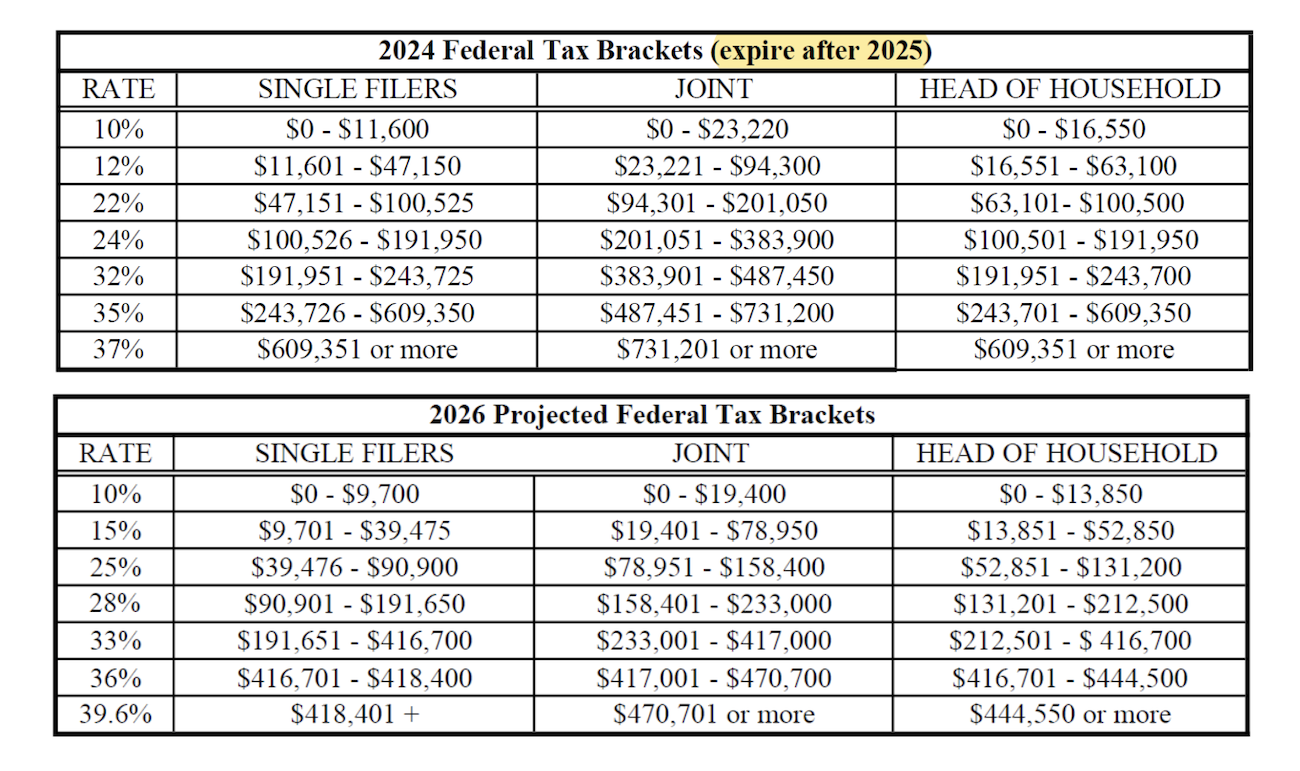
Here's what that looks like:

As you can see, the rates in 2026 are in some cases substantially higher than current rates. 

For example, if you're a couple who makes $250k combined right now, your marginal tax rate could jump from 24% to 33%. That's a big difference.

So how does that impact your decision on whether or not to do a Roth Conversion? 

Well, let's come back to that first question: "Will my tax rate be higher or lower in retirement?"

Let's say you're a married couple that brings in $200k combined taxable income. Right now, your marginal tax bracket is 24% and the top of that bracket is $383,900.

If you chose to do a Roth Conversion you would pay 24% federal income tax as long as you kept your total taxable income under $383,900. Since converting to Roth adds to your taxable income, that means you could convert a maximum of $183,900 (the difference between your $200k current taxable income and the top of the 24% bracket).

But why would you CHOOSE to pay 24% federal tax now when you don't have to?

Well, even if your income dropped to $100k in retirement, look at where that puts you in the 2026+ tax table: 25% federal taxes. 

So even though your retirement income is HALF of what it is now, your tax rate will likely still be HIGHER down the road. 

Converting, and paying 24% now allows you to avoid paying 25%+ when you withdraw the money in retirement. 

Consideration 2: Required Minimum Distributions

OK, so in the example above, the person was able to save 1% on their tax rate. That's great, but maybe not good enough to convince you that a conversion is worth it. 

conversions get much more beneficial for people who have large Traditional TSP balances and relatively low spending. 

Here's an example to demonstrate why:

Let's say there's a single filer with an employment income of $100k. This puts them in the 24% bracket. 

When they retire from their 30-yearr federal career, they have a $30k/year FERS pension and $3k/month ($36,000/year) Social Security payments. This gives them an annual guaranteed income of $66,000. This would be the 25% bracket in 2026+.

This person lives a fairly frugal lifestyle so that $66k covers most of their living expenses, and they don't need to make regular withdrawals from the TSP. 

Because this person is frugal, they've been a great saver for their whole career, and when they retire they have a $1 million Traditional TSP balance. Since they're not using it for their living expenses, by the time they turn 75 (Required Minimum Distribution age), they have $1.5 million in the TSP. 

For your first RMD, you're required to take 3.65% from your Traditional TSP. 3.65% of $1.5 million is $54,750.

Now, with almost $55k in additional income that they don't need, this person has a total income of $121k, putting them in the 28% bracket. Not to mention, the RMD rate goes up each year.

If this person would have taken the opportunity to convert some of their Traditional assets while they were paying a 24% rate, they would have lowered the amount of RMDs that they had to take, and saved themselves from paying tax at 28%. 

Conclusion

These are just two examples of how a federal employee's tax rate can be higher in retirement than it is now. In both of these scenarios, Roth conversions likely could have saved them money on their taxes. 

In order to decide if conversions make sense for you, use the examples that we included above and plug in your own numbers. 

Map out your income from now through retirement and determine if there are any years where you'll be paying a lower tax rate. Oftentimes there's a lower income period between the year someone retires and the year they start social security.  These are great years for Roth conversions. 

Austin Costello is a certified financial planner with Capital Financial Planners. If you'd like help deciding if/when you should be doing Roth conversions, you can register for a complimentary check up. 

_._,_._,_

Groups.io Links:

You receive all messages sent to this group.

View/Reply Online (#3748) | Reply To Group | Reply To Sender | Mute This Topic | New Topic
Your Subscription | Contact Group Owner | Unsubscribe [prefander.leadersworkshop@blogger.com]

_._,_._,_