Leaders Workshop

Soft Skills Development & Training

Blog Archive

Powered by Blogger.
[TSPStrategy] Planning a career change in 2024?

[TSPStrategy] Planning a career change in 2024?

https://www.govexec.com/pay-benefits/2024/01/planning-career-change-2024/393084/?oref=ge_retirementplanning_nl

Planning a career change in 2024?

If a new career outside of the federal workforce is on your list of resolutions, here are a few things you need to know about your benefits.

It's a new year and for some federal employees, it is time for a career change.  If you are planning to leave federal service, it is important to understand what benefits you will take with you and which ones you will leave behind. Here is a list of important things to know before you go: 

TSP Vesting 

It takes three years for most employees covered under FERS to be "vested" in the Thrift Savings Plan. When it comes to retirement savings plans, vesting means you can keep all of the money in your account when you leave federal employment. TSP participants are immediately vested in their own contributions and any agency matching contributions which allows employees who leave federal service to keep the money they've saved along with the matching funds regardless of your length of federal employment. 

However, there is a minimum amount of time in service a TSP participant must meet in order to be vested in the Agency Automatic (1%) Contributions and associated earnings in their accounts. If a FERS employee separates from federal service before meeting the TSP vesting requirement, the Agency Automatic (1%) Contributions and associated earnings will be automatically forfeited to the TSP. A FERS employee who dies in service is deemed to be vested in the TSP, no matter how many years of service the employee had completed. Consequently, an employee's beneficiary (or beneficiaries) will be entitled to all the funds in the employee's account. As long as you have a balance of $200 or more, you may maintain your vested TSP account balance even after you separate from federal employment. 

Once you leave the federal government, you'll no longer be able to make employee contributions. However, you can still change your investment mix, transfer eligible money into your account, and enjoy the low cost of the TSP while your account continues to accrue earnings. 

As you prepare to leave federal service, here are some important things you must do: 

  • Make sure the TSP has your current address at all times. 
  • If you have any TSP loans, decide if you want to pay them off, keep them open and set up monthly payments, or allow them to be foreclosed and accept the outstanding balance and accrued interest as taxable income. 
  • Read the TSP booklets Distributions and Tax Rules about TSP Payments to fully understand your options and their consequences. 

TSP Tax Information 

You've saved for your retirement and plan to use these savings to make life after retirement financially comfortable which also involves careful tax planning so that you can keep more of the money that you've accumulated. TSP contributions fall into two categories for income tax purposes:  pre-tax and post-tax. Pre-tax contributions are considered "traditional" and post-tax contributions are "Roth." Traditional TSP contributions grow tax-deferred which means when you elect to withdraw your funds, the entire amount will be subject to income tax, including the earnings. According to AARP, these eight states don't tax income at all: Alaska, Florida, Nevada, South Dakota, Tennessee, Texas, Washington and Wyoming. New Hampshire, only taxes capital gains and dividend income. And Alabama, Illinois, Iowa, Hawaii, Mississippi and Pennsylvania exclude pension income from state taxes. 

Roth TSP contributions grow tax-free, however, there are certain requirements that must be met to make tax-free withdrawals that include the earnings. For a distribution to be qualified, you must be 59 1/2 or older, permanently disabled, or deceased, and five years must have passed since your first Roth contribution. For important tax information, see TSP Publication 26. Be careful if you separate prior to the year you reach age 55. TSP withdrawals may be subject to a 10% early withdrawal penalty on top of the income tax due on your withdrawal. If you rollover or transfer your funds to an IRA, you may need to wait until age 59 1/2 to take a penalty-free withdrawal. See page 3 of TSP Publication 26 for all of the exceptions to the 10% early withdrawal penalty tax.   

Social Security and the FERS Special Retirement Supplement 

Reduced Social Security retirement benefits are payable starting at age 62 and can be delayed until age 70 to earn delayed retirement credits. Considerations for choosing the starting date for Social Security retirement may be influenced by the age when you stop earning substantial income and whether it is more important to have a smaller benefit for more years or a larger benefit for fewer years, after all, the end date will be the same. According to the Social Security Administration, the major source of income for most people over age 65 is Social Security. Nearly nine out of 10 people ages 65 and older were receiving a Social Security benefit as of June 30, 2023. Social Security benefits represent about 30% of the income of people older than 65. Among Social Security beneficiaries aged 65 and older, 37% of men and 42% of women receive 50% or more of their income from Social Security. Among Social Security beneficiaries aged 65 and older, 12% of men and 15% of women rely on Social Security for 90% or more of their income. Federal retirees have the advantage of an additional stream of lifetime retirement income from CSRS or FERS retirement benefits. Additionally, many federal retirees have substantial savings in the TSP to allow additional flexibility in claiming Social Security retirement benefits. To learn more about your Social Security benefits, visit Social Security Administration's website 

Many federal employees are eligible to retire before they qualify for Social Security retirement benefits. To bridge the gap between retirement and age 62, a FERS retiree may be entitled to a Special Retirement Supplement. Federal employees who file for an immediate unreduced retirement at their Minimum Retirement Age with 30 or more years of service or at age 60 with 20 or more years are eligible for a Special Retirement Supplement. Also those who retire under the special provisions for law enforcement, firefighters and air traffic controllers are also entitled to this benefit. The supplement ends at age 62 and is subject to an earnings test which can reduce or terminate the benefit sooner than age 62. If you want Social Security retirement to begin at age 62, you must file for benefits up to four months before you want your benefit to begin.    

FERS Vesting  

It takes five years of creditable civilian federal service covered under FERS to be vested for a FERS Basic Retirement Benefit. Depending on your age when you separate from federal service, this may be a benefit payable immediately or you may be entitled to a deferred retirement at a later age. Survivor benefits for eligible family members are payable once you have completed 18 months of creditable civilian employment.  Disability retirement benefits for employees who have a condition that will prevent them from performing their job duties for at least a year or who have a permanent disabling condition may be available after 18 months of civilian service upon approval from the Office of Personnel Management.   

Immediate Optional Retirement:  FERS 

An immediate, unreduced retirement benefit under FERS is payable at the MRA, which is age 57 if you were born in 1970 or later, if you have performed at least 30 years of creditable service. If you are 60, you only need to have 20 years to avoid an age reduction. At age 62, the minimum service requirement is 5 years for an unreduced immediate annuity. For most employees, the benefit is computed at 1% x your high-three average salary (the highest average basic pay over any three consecutive years of service) x years / months of creditable service. The factor changes to 1.1% for employees retiring at age 62 with 20 or more years of service credit. 

Be sure to meet with your benefits office at least 60 days before your chosen date of separation to receive a retirement estimate and additional information you will need to transition to retirement. Your agency personnel and payroll office will start processing your case after your official date of separation for retirement. 

To begin the retirement process, complete Form SF 3107, FERS Application for Immediate Retirement (SF 2801 for CSRS and CSRS Offset). The completed form should be submitted to your benefits office at least 60 to 90 days prior to your planned retirement date. To learn more about processing an immediate retirement, see OPM's Quick Guide to Processing Retirement. Be sure to keep copies of your signed application and if possible, keep a copy of your personnel file (Official Personal Folder or electronic Official Personnel Folder). If you require assistance after retirement, contact OPM at 888-767-6738 and have your claim number ready. Your Civil Service Active number that identifies you as an "annuitant" is provided to you approximately six weeks following your retirement. 

Deferred Retirement:  FERS 

A deferred retirement is payable at age 62 if you have completed at least five years of creditable civilian service before you left federal employment. You would also be eligible for a deferred retirement at your FERS MRA if you have completed at least 10 years of creditable service (five years must be civilian service) and you left federal service before reaching your MRA. Your annuity will be reduced by 5/12 of 1% for each full month (5% per year) that the beginning date of your retirement precedes your 62nd birthday.  

To avoid a reduction for age, it is very important to choose to have your annuity begin on the first day of the month following the month in which you reach your MRA if you left federal service with 30 or more years of service. If left with 20 to 30 years of service choose the first day of the month after your 60th birthday. A deferred retirement can begin on the first day of any month which is at least 31 days after OPM receives your application for retirement if you have reached your MRA but before your 62nd birthday.  If you separated with less than 20 years of service (and more than 5 years), you can avoid the age reduction altogether if you choose the first day of the month that you reach age 62 as your annuity beginning date.  Complete application RI 92-19 to apply for a deferred retirement.   

Example 1:  Mandy left federal service with 20 years of creditable service at age 46.  Her birthday is June 15.  To avoid the age reduction, she will file an application for deferred retirement about 60 days before she reaches age 60 and will elect for her annuity to begin on July 1st of the year she turns 60. 

Example 2:  Matthew left federal service at age 38 with 12 years of creditable service.  His birthday is November 20.  He must wait until age 62 to apply for an unreduced deferred retirement benefit.  He should elect for his retirement to commence on November 1 of the year he turns 62.   

Postponed Immediate MRA + 10 Retirement:  FERS 

If you leave federal service after attaining your MRA and you have completed at least 10 years of creditable service, you are eligible for an immediate retirement and may be eligible to continue your insurance benefits into retirement (FEHB, FEGLI, and FEDVIP). It is extremely important to choose the correct beginning date for your retirement if you wish to maintain these benefits. If you choose to postpone filing your application to avoid the age reduction, your annuity must begin the first day of the month that you reach age 62 or the first day of the month after your 60th birthday if you had at least 20 years of service at your separation from federal employment. If you are willing to accept the age penalty, you may elect to have your annuity commence the first day of any month following your resignation or on the first day of any month which is at least 31 days after OPM receives your application but before your 62nd birthday. If your annuity commences after your 62nd birthday, you WILL NOT BE ELIGIBLE TO REINSTATE YOUR INSURANCE COVERAGE and you will be considered retired under a deferred annuity. Complete application RI 92-19 to apply for a postponed MRA + 10 retirement.   

Example 1:  Cecil left federal service at age 57 with 22 years of federal service.  His birthday is March 18.  He will file his application for a postponed MRA + 10 retirement about 60 days before he turns 60 and elect for his annuity to begin on April 1.   

Example 2:  Margaret left federal service at age 58 with 19 years of service.  Her birthday is September 29.  She will apply for her retirement about 60 days before her 62nd birthday and will elect for her retirement to begin on September 1 (before her 62nd birthday).   

Continuation of Federal Employees Health Benefits (FEHB) 

As long as you participated in the FEHB program for the five years of service immediately preceding your last day of federal employment (or continually from your earliest opportunity), you may continue coverage if you are eligible for an immediate unreduced retirement or an MRA + 10 retirement if you separated from federal employment at your MRA or later with at least 10 years of service.  See the above requirements for reinstating your insurance if you choose to postpone your immediate MRA + 10 annuity. For more details on continuation of FEHB in retirement see the FEHB Handbook.  When you postpone your MRA + 10 retirement application, you will also postpone your FEHB coverage until it is reinstated when your FERS annuity begins. 

Continuation of Federal Employees Group Life Insurance (FEGLI)  

As long as you participated in the FEGLI program for the five years of service immediately preceding your last day of federal employment (or continually from your earliest opportunity), you may continue coverage that was in effect for the last five years of your career if you are eligible for an immediate unreduced retirement or an MRA + 10 retirement if you separated from federal employment at your MRA or later with at least 10 years of service. See the above requirements for reinstating your insurance if you choose to postpone your immediate MRA + 10 annuity. For more information on continuation of FEGLI in retirement see the FEGLI Handbook pages 114 - 131. When you postpone your MRA + 10 retirement application, you will also postpone your FEGLI coverage until it is reinstated when your FERS annuity begins. 

Federal employees Dental and Vision Insurance Program (FEDVIP) 

If you were enrolled in FEDVIP when you left federal service and you had 10 or more years of service and separated at your MRA or later, you are eligible to reenroll in FEDVIP. When you postpone your MRA + 10 retirement application, you will also postpone your FEDVIP coverage until your FERS annuity begins. 

Federal Employees Long Term Care Insurance Program (FLTCIP) 

If you leave government employment, you can keep your coverage as long as you continue to pay the required premium and have not exhausted your maximum lifetime benefit. OPM suspended applications for coverage under the FLTCIP to allow OPM and the FLTCIP carrier, John Hancock Life & Health Insurance Company, the time to thoroughly assess benefit offerings and establish sustainable premium rates that reasonably and equitably reflect the cost of the benefits provided, as required under 5 U.S.C. 9003(b)(2). For additional information about FLTCIP premiums, you may visit LTCFEDS.com/about-premiums. 

To learn more about your federal retirement and insurance benefits, visit: 

OPM Insurance or OPM Retirement Center.


_._,_._,_

Groups.io Links:

You receive all messages sent to this group.

View/Reply Online (#3749) | Reply To Group | Reply To Sender | Mute This Topic | New Topic
Your Subscription | Contact Group Owner | Unsubscribe [prefander.leadersworkshop@blogger.com]
_._,_._,_
[TSPStrategy] When do Roth conversions make sense for your retirement funds?

[TSPStrategy] When do Roth conversions make sense for your retirement funds?

https://www.govexec.com/pay-benefits/2024/01/when-do-roth-conversions-make-sense-your-retirement-funds/393018/?oref=govexec_today_nl

When do Roth conversions make sense for your retirement funds?

Paying federal taxes now may be better for you in the long run, explains one financial advisor.

One of the most common questions high-earning federal employees have as they near retirement is how to save money on their taxes.

There are a few strategies that can be used to avoid taxes over your lifetime, but one of the most common is to carry out Roth conversions. 

A Roth conversion is when you "convert" some or all of your Traditional (pre-tax) assets – typically in a Traditional IRA – to a Roth (after-tax) account – typically a Roth IRA. 

The basic idea is that you're choosing to pay tax now on whatever amount that you convert, in order to move that money into an account where it will grow tax-free from this point forward. 

In its simplest form, the decision in favor or against a Roth Conversion can be boiled down to one question: Are you paying a lower tax rate now than you will be in retirement? 

If yes, there's a good chance that conversions make sense. 

If not, a conversion likely does not make sense. 

But how do you know what your tax rate will be now vs in retirement? Many people assume that their rate will be lower in the future because they won't have their employment income. But that's a dangerous assumption to make, especially for federal employees. 

Once you add up your pension, Social Security, and distributions from your TSP (required or not), many feds end up with an income very similar to – if not higher than – what it was during their working years. 

Let's start by listing a few generalizations, specific to federal employees. 

Many feds in the FERS retirement system fit into the following scenario:

  1. Their income is higher during their working years than in retirement (but maybe not by much)
  2. In retirement, they have multiple streams of guaranteed income – FERS pension & Social Security (and maybe a military pension or disability payments as well)
  3. On top of their guaranteed income, they have distributions from the Traditional side of the TSP, which are taxable as regular income.
  4. Typically between the FERS pension and Social Security, most of their spending needs are met, so…
  5. When Required Minimum Distributions start (age 73 or 75 depending on when you were born), and they're required to take money from the TSP, their taxable income increases to a level that's higher than what they actually require for living expenses.
  6. This extra income may push them into a higher tax bracket and they get upset that they're required to pay taxes on money they don't actually need.

Does that sound like an accurate representation of your financial picture? If so, you may be a good candidate for Roth conversions. 

Consideration 1: Current Tax Environment vs Future

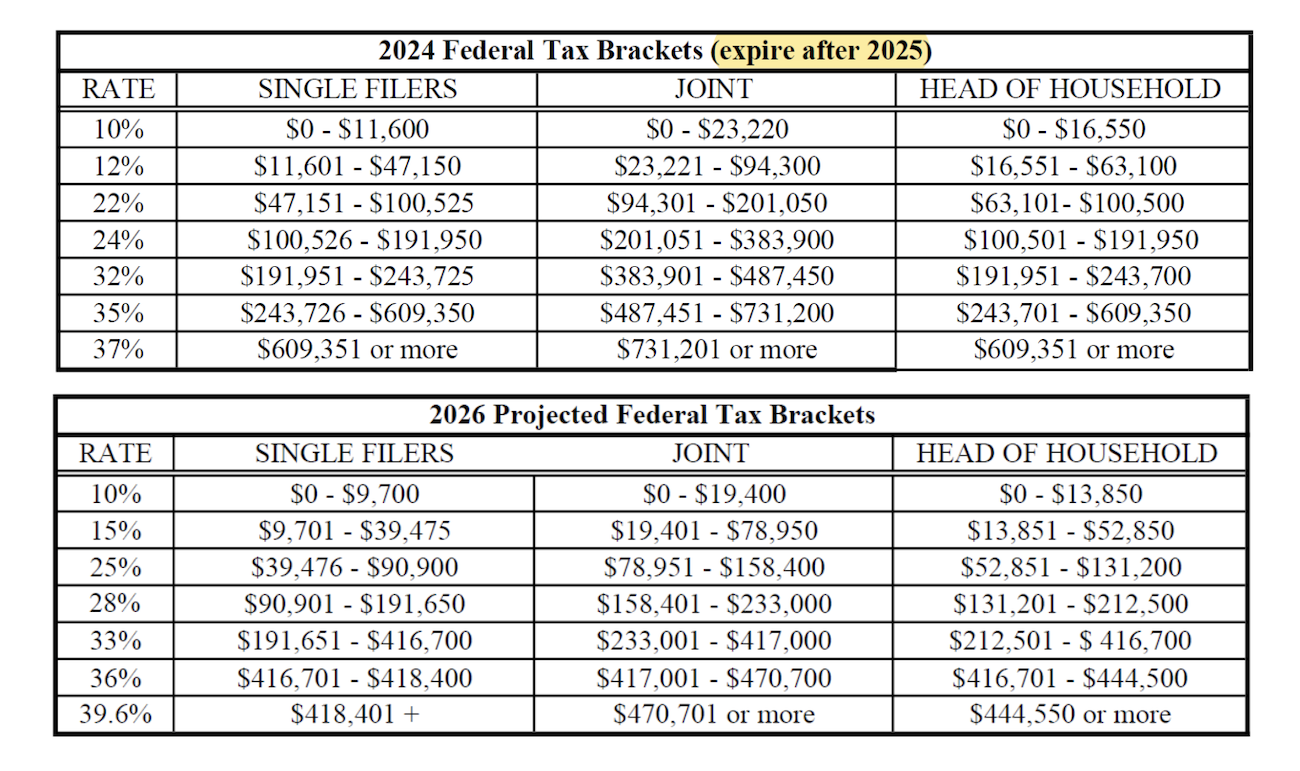
Right now our tax tables are defined by the Tax Cuts and Jobs Act which passed in 2018. This act effectively lowered each tax bracket from where they were previously. However, the thing that many people don't know is that the Act has an expiration date. 

Unless Congress is able to pass a law upholding the TCJA, or passes a new tax code completely, the Act will sunset after 2025. This means that if nothing happens (a likely scenario) our tax rates will go up in 2026.

Here's what that looks like:

As you can see, the rates in 2026 are in some cases substantially higher than current rates. 

For example, if you're a couple who makes $250k combined right now, your marginal tax rate could jump from 24% to 33%. That's a big difference.

So how does that impact your decision on whether or not to do a Roth Conversion? 

Well, let's come back to that first question: "Will my tax rate be higher or lower in retirement?"

Let's say you're a married couple that brings in $200k combined taxable income. Right now, your marginal tax bracket is 24% and the top of that bracket is $383,900.

If you chose to do a Roth Conversion you would pay 24% federal income tax as long as you kept your total taxable income under $383,900. Since converting to Roth adds to your taxable income, that means you could convert a maximum of $183,900 (the difference between your $200k current taxable income and the top of the 24% bracket).

But why would you CHOOSE to pay 24% federal tax now when you don't have to?

Well, even if your income dropped to $100k in retirement, look at where that puts you in the 2026+ tax table: 25% federal taxes. 

So even though your retirement income is HALF of what it is now, your tax rate will likely still be HIGHER down the road. 

Converting, and paying 24% now allows you to avoid paying 25%+ when you withdraw the money in retirement. 

Consideration 2: Required Minimum Distributions

OK, so in the example above, the person was able to save 1% on their tax rate. That's great, but maybe not good enough to convince you that a conversion is worth it. 

conversions get much more beneficial for people who have large Traditional TSP balances and relatively low spending. 

Here's an example to demonstrate why:

Let's say there's a single filer with an employment income of $100k. This puts them in the 24% bracket. 

When they retire from their 30-yearr federal career, they have a $30k/year FERS pension and $3k/month ($36,000/year) Social Security payments. This gives them an annual guaranteed income of $66,000. This would be the 25% bracket in 2026+.

This person lives a fairly frugal lifestyle so that $66k covers most of their living expenses, and they don't need to make regular withdrawals from the TSP. 

Because this person is frugal, they've been a great saver for their whole career, and when they retire they have a $1 million Traditional TSP balance. Since they're not using it for their living expenses, by the time they turn 75 (Required Minimum Distribution age), they have $1.5 million in the TSP. 

For your first RMD, you're required to take 3.65% from your Traditional TSP. 3.65% of $1.5 million is $54,750.

Now, with almost $55k in additional income that they don't need, this person has a total income of $121k, putting them in the 28% bracket. Not to mention, the RMD rate goes up each year.

If this person would have taken the opportunity to convert some of their Traditional assets while they were paying a 24% rate, they would have lowered the amount of RMDs that they had to take, and saved themselves from paying tax at 28%. 

Conclusion

These are just two examples of how a federal employee's tax rate can be higher in retirement than it is now. In both of these scenarios, Roth conversions likely could have saved them money on their taxes. 

In order to decide if conversions make sense for you, use the examples that we included above and plug in your own numbers. 

Map out your income from now through retirement and determine if there are any years where you'll be paying a lower tax rate. Oftentimes there's a lower income period between the year someone retires and the year they start social security.  These are great years for Roth conversions. 

Austin Costello is a certified financial planner with Capital Financial Planners. If you'd like help deciding if/when you should be doing Roth conversions, you can register for a complimentary check up. 

_._,_._,_

Groups.io Links:

You receive all messages sent to this group.

View/Reply Online (#3748) | Reply To Group | Reply To Sender | Mute This Topic | New Topic
Your Subscription | Contact Group Owner | Unsubscribe [prefander.leadersworkshop@blogger.com]

_._,_._,_
Re: [TSPStrategy] How to request required minimum distributions?

Re: [TSPStrategy] How to request required minimum distributions?

yea sure run from TSP and let a company that could go under run the show.


-------- Original message --------
From: dlstox <dlstox@gmail.com>
Date: 12/31/23 7:42 PM (GMT-06:00)
To: TSPStrategy@groups.io
Subject: Re: [TSPStrategy] How to request required minimum distributions?

Sounds like spam.  RUN!!!!!


From: TSPStrategy@groups.io <TSPStrategy@groups.io> On Behalf Of ShaneBro via groups.io
Sent: Sunday, December 31, 2023 7:12 PM
To: tspstrategy@groups.io
Subject: Re: [TSPStrategy] How to request required minimum distributions?


Best advice is to get out of TSP ASAP.  Open up an IRA acct. at one of the 3 major brokers and roll it all over asap.  Then if U want to invest in C, buy the etf "SPY", the C fund, "QQQ", bond "AGG".   You can replicate G easy, I have ten FDIC insured certificates of deposit from my broker making greater than 5%.  TSP is nothing but stumbling blocks to U enjoying your money, once retired.  U deserve better.


On Sunday, December 31, 2023 at 04:30:21 PM EST, Michael Smart via groups.io <msmart86=verizon.net@groups.io> wrote:


I am retired CSRS and have to take an RMD in 2024. I want to take one payment for the amount required for 2024. 

I logged in to my account but could not find anything specifically regarding how to do this. Taking a distribution as a rollover or a repetitive distribution requires a withholding of 20%, but I thought RMDs would be taxed at 10%. Anyone who has taken a RMD have any advice for me? Thanks.

Michael


On Dec 13, 2023, at 6:25 PM, dlstox <dlstox@gmail.com> wrote:


All,  I have been on vacation for a few weeks and away from my computer.  Here's something important to know about.  


What are some opinions of Medicare Advantage and why?


Thanks


Dave


https://www.govexec.com/pay-benefits/2023/11/open-season-medicare-advantage-or-disadvantage/392366/?oref=ge_retirementplanning_nl


Open Season: Medicare Advantage or Disadvantage?

Medicare Advantage options have only been offered through Federal Employees Health Benefits Program carriers since 2021 and may provide benefits that are not covered under traditional Medicare.

NOVEMBER 30, 2023

·         RETIREMENT PLANNING

·         RETIREMENT BENEFITS

·         BENEFITS

·         OPEN SEASON

Tammy Flanagan


Retirement Counseling and Training www.retirefederal.com

What do Joe Namath, David Ortiz, Magic Johnson, Joe Montana, Lionel Richie, Mike Huckabee, William Shatner, J.J. Walker, and William Devane all have in common? If you are near age 65 or older, you might know the correct answer. They were all featured in advertisements for Medicare Advantage plans. In 2023, nearly 31 million Medicare beneficiaries in the United States are enrolled in a Medicare Advantage plan, more than half of the eligible Medicare population.  

This statistic, however, is not true for federal retirees. Recent data shows that somewhere between 20% to 30% of Medicare eligible federal retirees are only enrolled in Part A of Medicare and only a small fraction of the 70% to 80 % of Medicare eligible federal retirees who are enrolled in both Parts A and B of Medicare have taken the extra step to enroll in the Medicare Advantage option offered by many plans in the Federal Employees Health Benefit Program for the 2024 plan year. This could be because Medicare Advantage options have only been offered through FEHB carriers since 2021. FEHB plans offering a Medicare Advantage benefit are not advertised by celebrities, but instead, you can find out more about these options on the Office of Personnel Management's website or you may check on your FEHB plan website or in Section 9 of your FEHB plan brochure. 

All Medicare Advantage plans, or Medicare Part C plans, as they are also known, provide all Medicare-covered benefits under Parts A and B, and usually provide Part D prescription drug benefits as well. Medicare Advantage plans may also provide benefits that are not covered under traditional Medicare, such as eyeglasses, some dental care, or gym memberships.  

·         FEHB plans that offer a Medicare Advantage option also provide a reduction in the Medicare Part B premium of $75 / month up to the full cost of Part B in certain plans. All nationwide FEHB fee-for-service plans will offer a Medicare Advantage benefit in 2024 except for the BC/BS FFS plans. Most of the FEHB HMO carriers will also provide this additional benefit of enrollment in a Medicare Advantage plan. There is no additional premium required to enroll in an FEHB Medicare Advantage option, however higher income enrollments will be subject to Income Related Monthly Adjustment Amounts surcharges for Medicare Part B and Medicare Part D.   

·         Enrollment in the Medicare Advantage Plan offered through many FEHB carriers is voluntary. Members must complete an application for enrollment in the Medicare Advantage option following their enrollment in the FEHB plan. Eligible enrollees voluntarily opt into the FEHB sponsored Medicare Advantage Plan and may opt out at any time. You may enroll in the FEHB Medicare Advantage Plan if: 

·         You are a retiree or annuitant enrolled in an FEHB that offers the added benefit of a Medicare Advantage Plan Option and have both Medicare Part A and Part B.  

·         You are a United States citizen or are lawfully present in the United States, and you reside in the United States, the District of Columbia or a United States territory.  

·         You do NOT have End-Stage Renal Disease. Enrollees who have ESRD cannot enroll until after the 30-month grace period has expired. Members diagnosed with ESRD while enrolled in the GEHA Medicare Advantage Plan may remain enrolled and ESRD services will be covered.  

·         You complete an application for enrollment in the FEHB Medicare Advantage Plan option by contacting the FEHB plan offering the Medicare Advantage option.  You will be asked to provide proof of your enrollment in Medicare A and B. 

Restrictions 

·         Commercially available Medicare Advantage plans restrict the health care providers that their enrollees can see (provider networks).  

·         FEHB plans offering a Medicare Advantage benefit may be less restrictive, however, you must be sure that your provider accepts Medicare, and they accept your plan. This tends to be less restrictive than the commercial Medicare Advantage plans, however, there are some providers who will not accept any MA plans. For example, Mayo Clinic in Arizona and Mayo Clinic in Florida do not accept Medicare Advantage Plans or Health Maintenance Organizations. 

·         Medicare Advantage plans are run through private companies, and they receive a stipend from the Centers for Medicare and Medicaid Services for each enrollee in the plan. This money is used to pay for the health care services used by the beneficiaries of the plan. Medicare Advantage plans may require more referrals and approvals for your care.   

Cost Sharing 

·         All Medicare Advantage plans include a limit of no more than $8,850 on out-of-pocket spending for in-network services and $13,300 for combined in-network and out-of-network services covered under Medicare Part A and B in 2024.      

·         FEHB plans offering Medicare Advantage benefits waive your cost-sharing for in-network providers and out-of-network providers who accept the plan leaving you with $0 out-of-pocket cost for most inpatient and outpatient medical care covered by Medicare and your FEHB plan.  

·         With a Medicare Advantage enrollment through a participating FEHB plan offering nationwide coverage, you can see any out-of-network doctor or health care provider that participates in Medicare and accepts the plan. Accepting the plan means the doctor is willing to treat you and bill the plan (providers do not bill Medicare when you are covered through a Medicare Advantage plan).   

·         Health Maintenance Organization FEHB plans also offer Medicare Advantage options, however, you will be required to see specific physicians, hospitals, and other providers that contract with the plan, and you must live or work in the geographic area specified by your plan.   

·         FEHB plans do not waive the cost sharing on most prescription drugs.  However, FEHB plans offering Medicare Advantage benefits provide a Medicare Advantage Prescription Drug Plan which sets a spending cap on out-of-pocket drug costs and lowers the copayments for certain medications.  Beware that the prescription drug formulary under the Medicare Advantage enrollment may be different from the original FEHB plan formulary for your medications. 

FEHB plans that offer Part D without enrolling in a Medicare Advantage plan 

The following FEHB plans are providing members who are enrolled in Medicare Part A and/or Part B with coverage under a Medicare Prescription Drug Plan that provides new protections under Medicare Part D but do not require enrollment in a Medicare Advantage option to receive these benefits:  

·         Aetna Direct,   

·         Foreign Service Benefit Plan and   

·         BC/BS Standard and Basic options,   

Although members covered by the above plans may be auto enrolled in this new Part D benefit for the 2024 plan year, it is possible to opt out of this new benefit by contacting your plan. For higher income enrollments, the Part D IRMAA surcharge may be charged.  In addition, Part D benefits are not available outside of the U.S. Another item of note is that you may not use a prescription drug discount card (i.e., GoodRx, Single Care, Senior65.com) along with your coverage in a Medicare Part D plan.   

Another benefit of the FEHB plans that offer incentives to enroll in Medicare A and B without the added enrollment in a Medicare Advantage benefit is your providers will bill Medicare for your healthcare services so that participants may see any doctor that accepts Medicare. BC/BS Basic requires that you use BC/BS Preferred Providers to receive benefits from this plan. HMO's have restricted provider networks although your coverage under Medicare A and B provides coverage outside of your FEHB plan network.  

According to Dennis Damp, who writes the Retirement Lifestyle newsletter, once you elect a MA plan (Medicare Part C), you will be automatically enrolled in a Medicare Part D drug plan at no additional cost unless you have higher income and are subject to the IRMAA surcharge. Those over 65 and new enrollees in the Medicare Advantage plan offered by many FEHB plans, may receive a late enrollment penalty letter for Part D from Social Security. If you receive this notice, call the plan to let them know. You will not be penalized for late enrollment when signing up through your FEHB plan for Medicare Advantage Part D benefits. Secondly, if you decide to opt out of the program you will not be penalized for Part D late enrollment if you decide to reenroll down the road. 

FEHB plans provide an excellent supplement as secondary payer to original Medicare (Parts A and B). You may enroll in a Medicare Advantage plan offered through many FEHB plans while remaining enrolled in the FEHB plan. Let's be clear: There are no FEHB plans that are Medicare Advantage plans (although you may find "advantage" in the plan title) just like there are no FEHB plans that are Medicare Supplemental plans.  Medicare supplemental plans and Medicare Advantage plans are sold by private companies, and most federal retirees eligible for FEHB coverage are not enrolled in these commercial plans. FEHB plan participants may "suspend" their FEHB coverage to enroll in a commercially available Medicare Advantage benefit using form RI 79-9 (Cancel or Suspend FEHB). You can find information on Medicare Advantage plan offered through many FEHB plans and for other incentives offered by FEHB plans to encourage enrollment in Medicare A and B, by contacting your FEHB plan or visiting your FEHB plan website.   

NOTE: Be sure to use OPM's resources to learn more about all FEHB plan options available to you in 2024. There are 68 FEHB participating carriers offering a total of 158 plan choices, however depending on where you live or work, you may have 17 nationwide plans plus five plans available to specific groups along with community or local HMOs where the number of options will vary by area.