Leaders Workshop

Soft Skills Development & Training

Blog Archive

Powered by Blogger.
[TSPStrategy] Survivor Benefit confusion: part one

[TSPStrategy] Survivor Benefit confusion: part one

https://www.govexec.com/pay-benefits/2023/10/survivor-benefit-confusion-part-one/391083/

Survivor Benefit confusion: part one

Choosing a survivor benefit should be a very simple decision, but often it can be complicated.

Every federal employee who completes a FERS (or CSRS) retirement application (SF 3107 for FERS and SF 2801 for CSRS and CSRS Offset) must choose what kind of retirement they want under the "Annuity Election" section of the application. There are five options to pick from:

  1. A reduced annuity with maximum survivor annuity for my spouse (if you are married at retirement, this is the "default" election).
  2. A reduced annuity with a partial survivor annuity for my spouse.
  3. An annuity payable only during my lifetime.
  4. A reduced annuity with a survivor annuity for a person who has an "insurable interest in me.
  5. A reduced annuity with survivor annuity for my former spouse(s).

This can be a very simple decision, or it can be complicated by factors such as a spouse who has their own retirement or the possible use of life insurance in lieu of the survivor election. The two most common choices are:

  • If you are single at retirement and there is no one who is financially dependent on you, then, #3 is most likely going to work for you. With this election, there is no reduction to your retirement. When you die, your retirement "dies" with you.  If choose #3 and you marry later, then you will have two years to elect a survivor annuity for a future spouse.  
  • If you are married on the day of retirement, then #1 is generally going to work well. Remember that if you are married and don't make this election, your spouse will be required to provide their notarized consent to either a partial or "no" survivor benefit election. While you and your spouse are both living, your retirement will be reduced by 10% (a little under 10% if you retire under CSRS or CSRS Offset). If you predecease your spouse, the benefit is equal to 50% of your unreduced annuity at the time of your death (55% if you are retiring under CSRS or CSRS Offset) and payable for the life of your surviving spouse. If your spouse is covered under your FEHB insurance plan, they can continue this coverage as well through the survivor annuity (a spouse who is a federal employee or annuitant may elect to transfer the FEHB coverage to their salary or annuity benefit). If your spouse precedes you, then you can notify OPM of your spouse's passing and have your annuity restored to the unreduced amount.  

While the retiree is living, the potential survivor benefit (payable to the spouse, former spouse and/or insurable interest) receives the same COLA increases the annuitant receives. When a FERS retiree dies, if the retiree had received no COLA increases because he or she was under age 62, there is no increase in the survivor benefit since the date of retirement. On the effective date of the next COLA, if at least one year has passed since the deceased retiree's annuity commenced, the survivor annuity is increased by a full COLA. If less than one year has passed, the COLA is prorated based on the retiree's annuity commencing date.

Example:  Based on her length of service and high-three average salary, Judy has an unreduced FERS retirement of $40,000/year and is retiring at age 62.  Electing the maximum survivor annuity will reduce this by $4,000/year (10 % of $40,000) so that her gross annuity is now $36,000. As her gross annuity is adjusted by COLA, the spousal survivor annuity is increased as well.  Let's say Judy has lived for 25 years and received an annual COLA of 3% each year so that her unreduced retirement is now $82,400. The survivor annuity will be $41,200/year (50% of $82,400) and her surviving spouse will continue to receive annual COLAs for the rest of their life. If her spouse dies first, her reduced retirement ($74,160/year) will be increased to the unreduced amount of $82,400 upon notification to OPM of your spouse's death.

What about the other options?  

Partial Spousal Survivor Annuity

This option can work for a couple when the spouse of the annuitant doesn't need the money provided by the CSRS or FERS retirement if the federal retiree dies first, but they need their health insurance to continue. The only way to continue FEHB coverage for a surviving spouse who is not entitled to FEHB coverage through their own federal employment or retirement is to provide a survivor benefit. Under FERS, the partial survivor benefit election will cause your retirement to be reduced by five% instead of ten%. If you die first, your spouse will receive 25% instead of 50 % of your unreduced FERS annuity (if your spouse is under age 60 at the time of your death, they may also be entitled to a FERS supplement).   

Insurable Interest Survivor Benefit Election

This is not a common election because this election results in a permanent reduction to your CSRS or FERS retirement based on the difference between your age and the person you are naming. For example, if you have three children and want to provide an insurable interest survivor annuity, the first problem is you would have to choose only one of your children since the benefit cannot be shared. Secondly, let's say you choose your child who was born when you were 31 years old. This would cause a 40% reduction in your retirement benefit due to the age difference (see below). Upon your death, this child would be entitled only to 555 of the reduced benefit amount.  

One last thing, to make this election, you must provide medical documentation showing that you are in good health (insurable) at your own expense. According to OPM, "insurable interest" is an insurance term which applies to someone who would reasonably expect to derive financial benefit from your continued life. For survivor benefit election purposes, an insurable interest is presumed to exist if you name as beneficiary of the insurable interest, any of the following individuals:

  • Spouse;
  • blood or adopted relative closer than first cousins;
  • ex-spouse;
  • person to whom you are engaged to be married;
  • person with whom you are living in a relationship that would constitute a common-law marriage in a jurisdiction that recognizes common-law marriages.

If the person named is not one of the above, you should submit affidavits with your retirement application from one or more people with knowledge of the individual's insurable interest. The affidavits should state the relationship between you; the extent to which the person named is dependent on you; the reasons why the person named might reasonably expect to derive financial benefit from your continued life.

The reduction to provide an insurable interest benefit is computed as follows. If the person named is:

  • is older, the same age, or less than 5 years younger than the retiree, the reduction is 10%;
  • is 5 but less than 10 years younger than the retiree, the reduction is 15%;
  • is 10 but less than 15 years younger than the retiree, the reduction is 20%;
  • is 15 but less than 20 years younger than the retiree, the reduction is 25%;
  • is 20 but less than 25 years younger than the retiree, the reduction is 30%;
  • is 25 but less than 30 years younger than the retiree, the reduction is 35%; or
  • is 30 or more years younger than the retiree, the reduction is 40%.

The insurable interest automatically ends if the insurable interest dies, if you marry the insurable interest and elect to provide a spousal benefit, or if the named person is your spouse and you change your election to provide a spousal survivor benefit.

Reduced Annuity with Survivor Annuity for My Former Spouse(s)

You do not need to make this election if a court order provides a survivor annuity for your former spouse. OPM must honor the terms of the court order, except that a former spouse cannot receive a survivor annuity by court order unless:

  • The marriage lasted at least nine months;
  • If an employee dies in service, the employee must have at least 18 months of service subject to retirement deductions;
  • The former spouse has not remarried before reaching age 55.  This does not apply if you and your former spouse were married for 30 years or longer.

If your former spouse is not entitled to a survivor annuity by court order, the option to elect a survivor annuity is available at the time of retirement. If you are currently married, your spouse's consent is required since anything elected for a former spouse using this option will limit the benefit payable to your current spouse. The maximum combined survivor benefits that can be selected for a former spouse(s) and current spouse is 50% of your FERS benefit or 55% of your CSRS or CSRS Offset benefit.

Protecting a Current Spouse When Survivor Benefits are Payable to a Former Spouse through a Court Order

If a court order provides a survivor annuity to your former spouse and you are remarried, you should make your election for your current spouse as if the court order didn't exist. If your former spouse loses entitlement because of remarriage before 55 or death, then your current spouse would have the right to the maximum benefit elected. If the former spouse and your current spouse both survive you, OPM will honor the court order first and your current spouse would be eligible for any portion not ordered for the former spouse.  

You may also provide your current spouse with an "insurable interest" survivor election at retirement which would require that your spouse waive their right to the regular spousal benefit. This would require a reduction to your retirement to honor the court order and then a second reduction for the Insurable Interest election. If your former spouse dies first, you can change the insurable interest election back to a spousal benefit for your current spouse. If your spouse and your former spouse both survive you, then upon your death, OPM would honor the court order first and provide your current spouse with 55% of your reduced annuity.  

_._,_._,_

Groups.io Links:

You receive all messages sent to this group.

View/Reply Online (#3728) | Reply To Group | Reply To Sender | Mute This Topic | New Topic
Your Subscription | Contact Group Owner | Unsubscribe [prefander.leadersworkshop@blogger.com]

_._,_._,_
[TSPStrategy] The federal retirement backlog just hit another recent record low

[TSPStrategy] The federal retirement backlog just hit another recent record low

https://www.govexec.com/pay-benefits/2023/10/federal-retirement-backlog-just-hit-another-recent-record-low/391023/

The federal retirement backlog just hit another recent record low

The Office of Personnel Management's inventory of pending retirement claims from former federal workers reached its lowest level since 2017 for the second time this year.

The federal government's backlog of pending retirement claims from former federal workers hit a six-year low for the second time this year in September.

The Office of Personnel Management reported Thursday that its retirement backlog fell to 15,852 pending cases at the end of last month, the lowest it has been since the inventory briefly fell to around 14,000 claims in 2017. OPM's goal is a "steady state" of 13,000 pending retirement claims at any given time.

Last month's figure shatters the previous six-year record—16,370—that the agency achieved in June. The retirement backlog has fallen in six of the last nine months.

Last month, OPM also saw improvement in its statistics measuring the average amount of time it takes the agency to process a retirement claim. On a monthly basis, the average processing time fell from 74 days in August to 70 last month, while the average time for fiscal 2023 was 77 days.

The retirement backlog has long been a pain point for the HR agency, as it has sought to develop a plan to make the retirement process less paper-based. Those woes were exacerbated by the COVID-19 pandemic, with the backlog reaching a high of more than 36,000 pending claims in March 2022.

Last month, OPM published its long-awaited IT strategic plan, which, among other things, prioritizes modernizing the retirement process. Between now and 2026, the agency will pilot a "digital retirement system" as well as move to electronic retirement records and an online retirement application process.

But in the meantime, officials have focused on ways to make the retirement process more transparent for federal workers, as well as educate them on how to properly apply for retirement, since human error during the application process is the No. 1 cause of delays in processing a claim.

Last May, OPM published a new "quick guide" to navigating the federal retirement process, including a breakdown of what agencies are responsible for which phase of the process, a checklist of steps federal workers can take to ensure their retirement claim is processed quickly, as well as an estimated timeline for each step in the process, updated on a monthly basis.


_._,_._,_

Groups.io Links:

You receive all messages sent to this group.

View/Reply Online (#3727) | Reply To Group | Reply To Sender | Mute This Topic | New Topic
Your Subscription | Contact Group Owner | Unsubscribe [prefander.leadersworkshop@blogger.com]
_._,_._,_
[TSPStrategy] World Investor Week: Learn more and protect yourself

[TSPStrategy] World Investor Week: Learn more and protect yourself

https://www.govexec.com/pay-benefits/2023/10/world-investor-week-learn-more-and-protect-yourself/390880/

World Investor Week: Learn more and protect yourself

The global campaign promoted by the International Organization of Securities Commissions aims to raise awareness about the importance of investor education and protection.

Did you know that Oct. 2 to 8 is World Investor Week? The global campaign promoted by the International Organization of Securities Commissions aims to raise awareness about the importance of investor education and protection, and highlight the various initiatives of securities regulators in these two critical areas.  

This year, the WIW campaign will focus on three main themes: Investor Resilience, Crypto Assets, and Sustainable Finance, and the Financial Industry Regulatory Authority posted an Investor Bulletin to explain them. 

Here are some things to consider that may be relevant to your retirement planning.

Investor Resilience

Plan for unexpected investment challenges by having strategies for budgeting to reduce the impact of inflation, avoiding high-interest debt, and managing risk. It is important to diversify and  spread your money between different types of investments. 

In the Thrift Savings Plan, the federal government's 401(k)-style retirement savings program, you may diversify between the core C, F, G, S, and I funds by allocating a specific percentage of your contributions, and rebalancing your current investment between these five options. 

If you don't feel comfortable or knowledgeable enough to do this yourself, you may consider one of the Lifecycle Funds or L Funds. You can choose from L2025 through L2065 based on when you plan to start using the money to supplement your other retirement income. 

According to the TSP website, each of the 10 L Funds is a diversified mix of the five individual funds (G, F, C, S, and I). They were designed to let you invest your entire portfolio in a single L Fund and get the best expected return for the amount of expected risk that is appropriate for you.  Every three months, the target allocations of all the L Funds except L Income are automatically adjusted, gradually shifting them from higher risk and reward to lower risk and reward as they get closer to their target dates. When an L Fund reaches its target date, it goes out of existence and any money in it becomes part of the L Income Fund, which generally keeps the same target allocation. For example, in 2025, the L 2025 Fund will be rolled into the L Income Fund.

It is also important to pay off high-interest debt such as credit cards or other loans, and build up emergency savings. The recent threat of a government shutdown clearly highlights the need to have money quickly available for unexpected expenses or a sudden drop in income. Use gift money, tax returns or other "surprise" income to start saving three to six months of living expenses. Continue to save by setting up a direct deposit to your savings account every pay period.   

The third way to improve your investor resilience is to be aware that there are investment scams all around. They could be messages on social platforms or in the mainstream media. Before investing money, take steps to protect yourself from losing your money to a scam, for example, check that anyone offering or selling you an investment is licensed or registered

Crypto Assets

The TSP core funds do not include crypto assets such as bitcoin. Separated employees and employees eligible for an age-based in-service withdrawal may transfer TSP funds to an IRA to make these types of investments, which  can be speculative, risky, and volatile. 

If you are considering an investment opportunity involving crypto assets, you may be wondering if it is legal, if it is right for you, or even whether it might be a scam. Be cautious if you spot "guaranteed" high returns, unlicensed or unregistered sellers, skyrocketing account values, anything that sounds too good to be true, including testimonials on social media, even if they are from someone well-known who may have been paid to tout the investment. 

Check out the Securities and Exchange Commission's "HoweyTrade" video for information on spotting fraudulent investment promotions.  

Sustainable Finance

Sustainable investing, socially responsible investing and impact investing generally refer to environmental, social and governance investing or,  choosing companies to invest in based on one or more ESG factors. TSP's mutual fund window became available in the summer of 2022 and opened up the TSP to around 5,000 mutual funds, some of which offered ESG funds.  

Although this is one of the themes for World Investor Week, not everyone is in support.  Earlier this year, Sens. Mike Lee, R-Utah,  and Rick Scott, R-Fla., introduced the No ESG at TSP Act, crucial legislation to safeguard taxpayer dollars from ideologically driven investment funds. Rep. Chip Roy, R-Texas, introduced a companion bill in the House of Representatives. The bill addresses the growing concerns surrounding Environmental, Social, and Governance initiatives, which pose risks to our domestic energy supply and promotes divisive ideological agendas.

TSP Learning Opportunity

The Securities and Exchange Commission and Federal Retirement Thrift Investment Board developed Your TSP Account – What to Think About When Nearing Retirement or Considering Leaving the Government, a program open to all federal employees and members of the uniformed services, that is designed for those who may be considering retiring or leaving federal service.  The program covers the TSP's post-service distribution options, tax withholding information, IRS required minimum distribution rules and the IRS early withdrawal penalty. Discussion also covers investment risk and fees, the common red flags of investment fraud, how to check out a financial professional and questions to ask when thinking about moving funds from the TSP.

You can attend this program by viewing the video any time after Oct. 3. There is no need to register for the webcast.

Resources:

  • For questions about your TSP retirement, please go to the TSP website or call the TSP's ThriftLine at 877-968-3778 to speak to a TSP expert.
  • For investment-related questions, go to Investor.gov, call the SEC's investor assistance line at 800-732-0330 or email Help@SEC.gov. 
  • For more information on World Investor Week, see the SEC's World Investor Week page.
_._,_._,_

Groups.io Links:

You receive all messages sent to this group.

View/Reply Online (#3726) | Reply To Group | Reply To Sender | Mute This Topic | New Topic
Your Subscription | Contact Group Owner | Unsubscribe [prefander.leadersworkshop@blogger.com]
_._,_._,_
[TSPStrategy] A Closer Look at 2024 Federal Employee Health Benefits Premiums

[TSPStrategy] A Closer Look at 2024 Federal Employee Health Benefits Premiums

https://www.govexec.com/pay-benefits/2023/10/closer-look-2024-federal-employee-health-benefits-premiums/390856/

A Closer Look at 2024 Federal Employee Health Benefits Premiums

Wondering how the increase might impact your FEHB plan choice? We'll walk you through it.

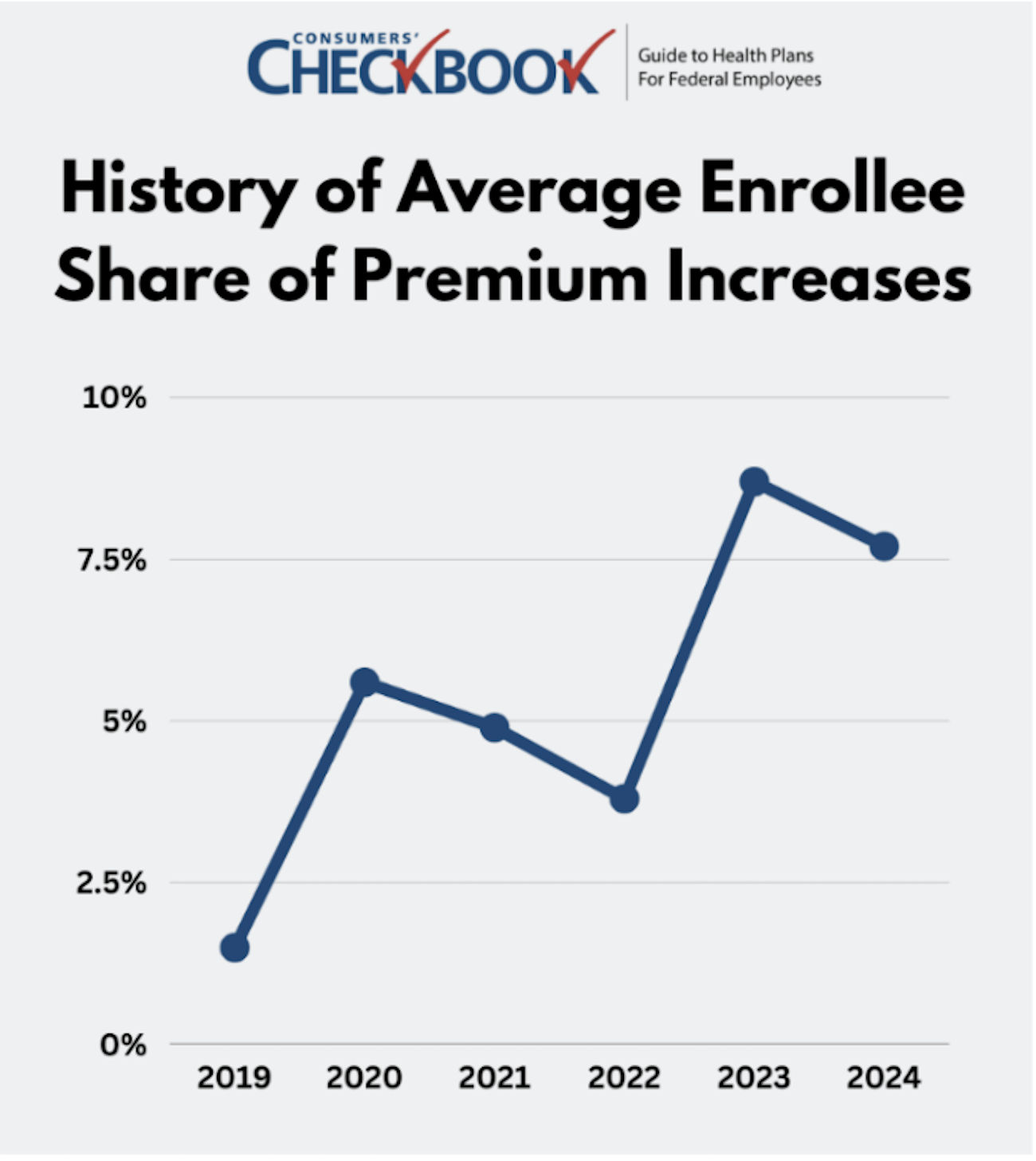
Last week, OPM released the first batch of information for the 2024 Federal Employee Health Benefits Open Season. Federal employees and annuitants will, on average, pay 7.7% more in FEHB premiums next year. OPM cites increased cost and use of prescription drugs, emergency room care, and outpatient care as the primary reasons for the increase in premiums.

How will higher premiums impact your FEHB plan choice for the upcoming open season? We'll walk you through changes in popular plans, discuss which ones saw their premiums increase above and below the average, provide enrollment advice for two-person families, and discuss FEDVIP dental and vision plan premium changes.

Recent History of FEHB Premium Increases

Next years 7.7% premium increase is less than the  8.7% increase of 2023, but it's still much higher than previous years. In 2022, the average enrollee increase was only 3.8%. While no one can predict the future, federal employees and annuitants should prepare to pay higher premiums and a higher rate of increase going forward. 

How Premiums are Changing in 2024

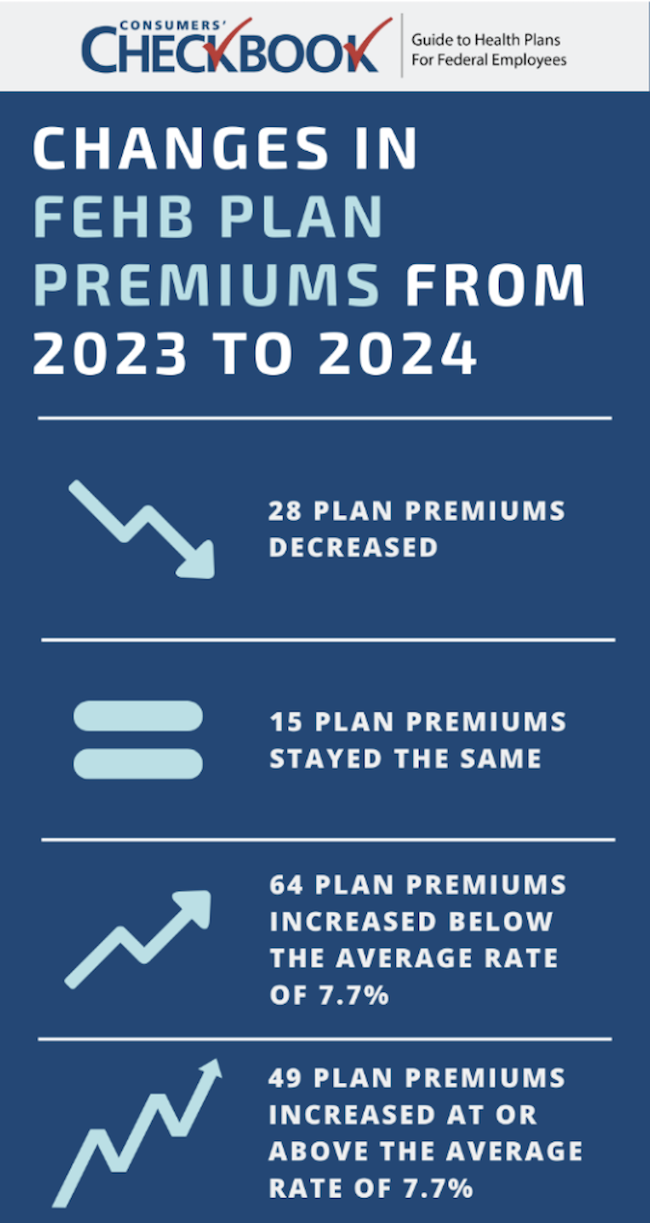
While the average enrollee share of premium is going up 7.7%, not all plans reflect that trend. For the 156 FEHB plans available in 2023 and 2024, premiums will decrease in 28 plans, stay the same in 15 plans, increase below the 7.7% average in 64 plans, and increase above the 7.7% average in 49 plans.

Some of the changes are striking. For example, the largest decrease in enrollee share of premium is from the Baylor Scott & White Standard Health Plan (A8), available in Central Texas, which costs 54% less in 2024, saving self-only enrollees around $1,500 next year. Aetna Advantage, a national PPO plan, has the same premium in 2024 as 2023. The largest increase in enrollee share of premium is from Kaiser Permanente High (F8) in the Atlanta region, which is 22% more in 2024 and will cost self-only enrollees around $1,100 more next year.

How is your plan's premium changing next year? Even if you're happy with your existing FEHB plan, it will most likely be more expensive in 2024. Not all premiums rose at the same rate, and there may be new plan bargains available to you, which is why it's important to know how this for-sure expense will impact your budget in 2024.

Blue Cross Blue Shield

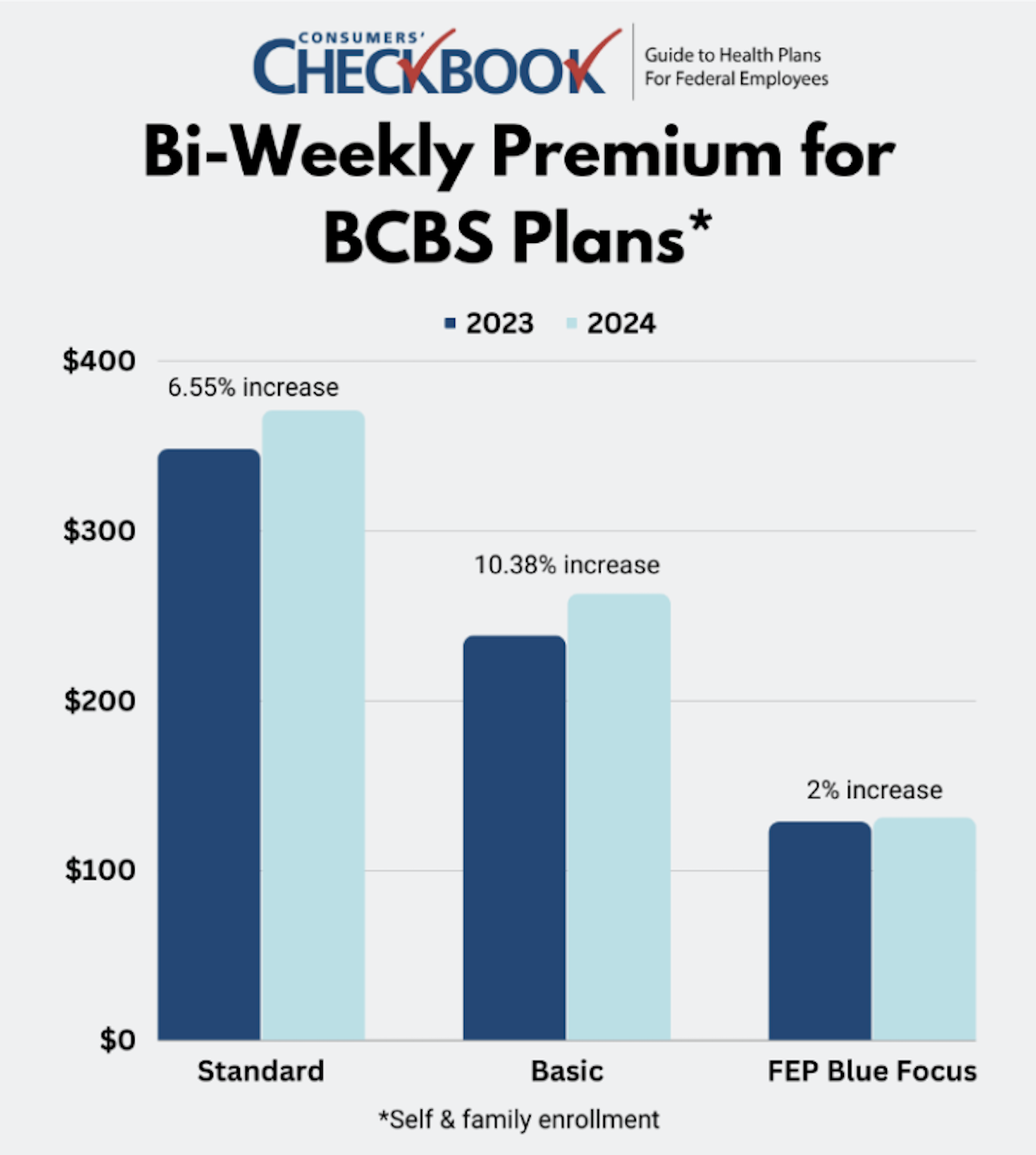
Almost two-thirds of federal employees are enrolled in one of the Blue Cross Blue Shield plans—Standard, Basic, or FEP Blue Focus. How did the BCBS plan premiums change?

Basic increased above the all-plan average, Standard increased just below the average, and FEP Blue Focus increased well below the average.

This upcoming Open Season is a good opportunity to assess whether your current plan is still the best fit for your needs. For Basic and Standard plan members, are you enrolled in the right BCBS plan? Now might be the opportunity for you to save one or two thousand dollars a year in premium by switching to FEP Blue Focus. 

Of course, there are many differences between the Standard, Basic, and FEP Blue Focus plans, but three of the most important are Standard is the only one where: 

  • You can see out-of-network providers, 
  • Receive mail-order prescription drugs (Basic has mail-order prescription drug coverage only for annuitants with Part B), 
  • And receive fertility coverage, including assisted reproductive technology (ART) coverage up to $25,000 annually (a new benefit for 2024). 

If you're enrolled in Standard and don't use those benefits, you'll save money switching to Basic or FEP Blue Focus and you'll get to keep your existing BCBS in-network providers.

Self-Plus-One vs Self & Family Enrollment

Married couples and two-person families can enroll as self-plus-one or self-and-family. Most of the time, self-plus-one is the cheaper enrollment choice, but not always. In 2024, there are 49 FEHB plans where self-&-family enrollment is less expensive than self-plus-one, and 11 plans where the premiums are the same.

There is a sizable amount of money at stake that you could save, or waste, based on your enrollment decision. For example, a two-person family considering the D.C.-area Kaiser High (E3) plan can save $59.68 bi-weekly enrolling as self-&-family compared to self-plus-one. That adds up to $1,552 annually.

You can find premiums by enrollment type on the last page of any FEHB brochure (found on the OPM plan comparison tool and Checkbook's Guide to Health Plans) once they are released in November, just before the start of Open Season. Look for the enrollee share of premium and choose the enrollment option that is cheaper. You receive the same plan benefits regardless of enrollment type. 

FEDVIP Premiums

FEDVIP premiums have historically increased at a much lower rate compared to FEHB plans. For 2024, FEDVIP dental plan premiums will increase 1.4% on average and FEDVIP vision plan premiums will increase by 1.1%.

The Final Word

Your FEHB premium will most likely go up in 2024, and possibly by quite a bit. The 7.7% increase is only an average, and many plans will cost more. While only one factor in your overall plan selection decision, the premium is important because it's a for-sure expense. You absolutely must check to see how yours is changing for 2024 and consider whether another plan is a better value for you and your family. The 2024 FEHB Open Season starts Nov. 13 and ends Dec. 11th\.

Kevin Moss is a senior editor with Consumers' Checkbook. Checkbook's 2024 Guide to Health Plans for Federal Employees will be available on the first day of Open Season, Nov.13. Check here to see if your agency provides free access. The Guide is also available for purchase and Government Executive readers can save 20% by entering promo code GOVEXEC at checkout.

_._,_._,_

Groups.io Links:

You receive all messages sent to this group.

View/Reply Online (#3725) | Reply To Group | Reply To Sender | Mute This Topic | New Topic
Your Subscription | Contact Group Owner | Unsubscribe [prefander.leadersworkshop@blogger.com]

_._,_._,_